Named entity search
TCSE supports searching for named entities recognized by spaCy's NER (Named Entity Recognition) system. Use the %ENTITY notation in advanced search mode to find specific types of named entities in TED Talk transcripts. Multi-token entities (e.g. "New York", "United Nations") are matched as a single unit.
How to use
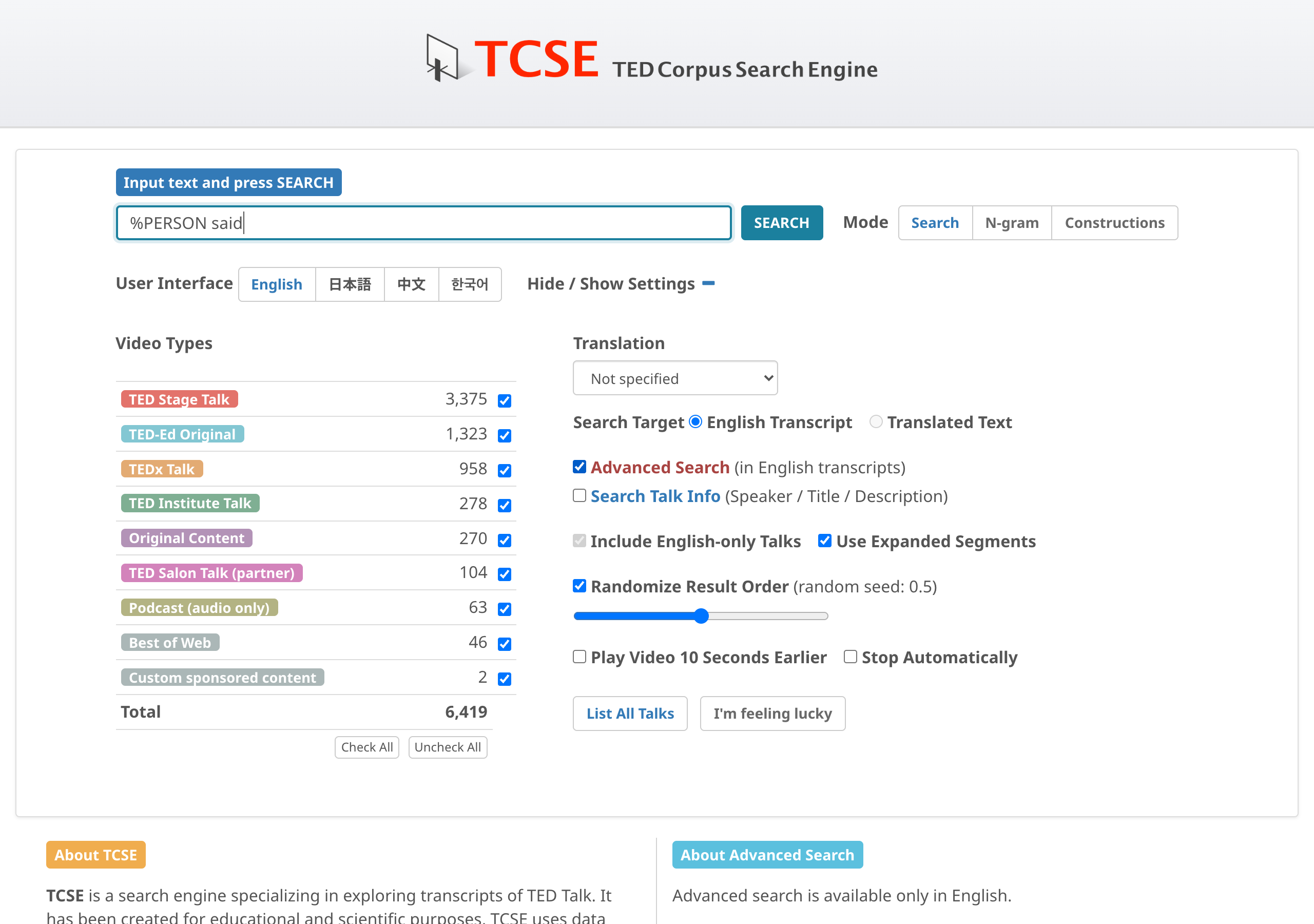
- Enter a query using the
%ENTITYnotation (e.g.,%PERSON said) - Check Advanced Search
- Click SEARCH
NER patterns in Collocation mode
You can also search for NER patterns in the Collocation mode. For example, searching %PERSON in 1-gram mode shows the total frequency of person entities across the corpus. Searching in 2-gram or higher modes reveals common patterns involving named entities (e.g., %PERSON said, in %GPE). Clicking on an n-gram result will automatically open the corresponding advanced search.
Entity types
TCSE recognizes 18 named entity types:
| Entity Type | Description |
|---|---|
%CARDINAL |
Numerals that do not fall under another type |
%DATE |
Absolute or relative dates or periods |
%PERSON |
People, including fictional |
%GPE |
Countries, cities, states |
%ORG |
Companies, agencies, institutions, etc. |
%ORDINAL |
"first", "second", etc. |
%NORP |
Nationalities or religious or political groups |
%LOC |
Non-GPE locations, mountain ranges, bodies of water |
%TIME |
Times smaller than a day |
%PERCENT |
Percentage, including "%" |
%QUANTITY |
Measurements, as of weight or distance |
%WORK_OF_ART |
Titles of books, songs, etc. |
%MONEY |
Monetary values, including unit |
%PRODUCT |
Objects, vehicles, foods, etc. (not services) |
%FAC |
Buildings, airports, highways, bridges, etc. |
%EVENT |
Named hurricanes, battles, wars, sports events, etc. |
%LANGUAGE |
Any named language |
%LAW |
Named documents made into laws |
Examples
| Query | What it finds |
|---|---|
%PERSON |
All person names |
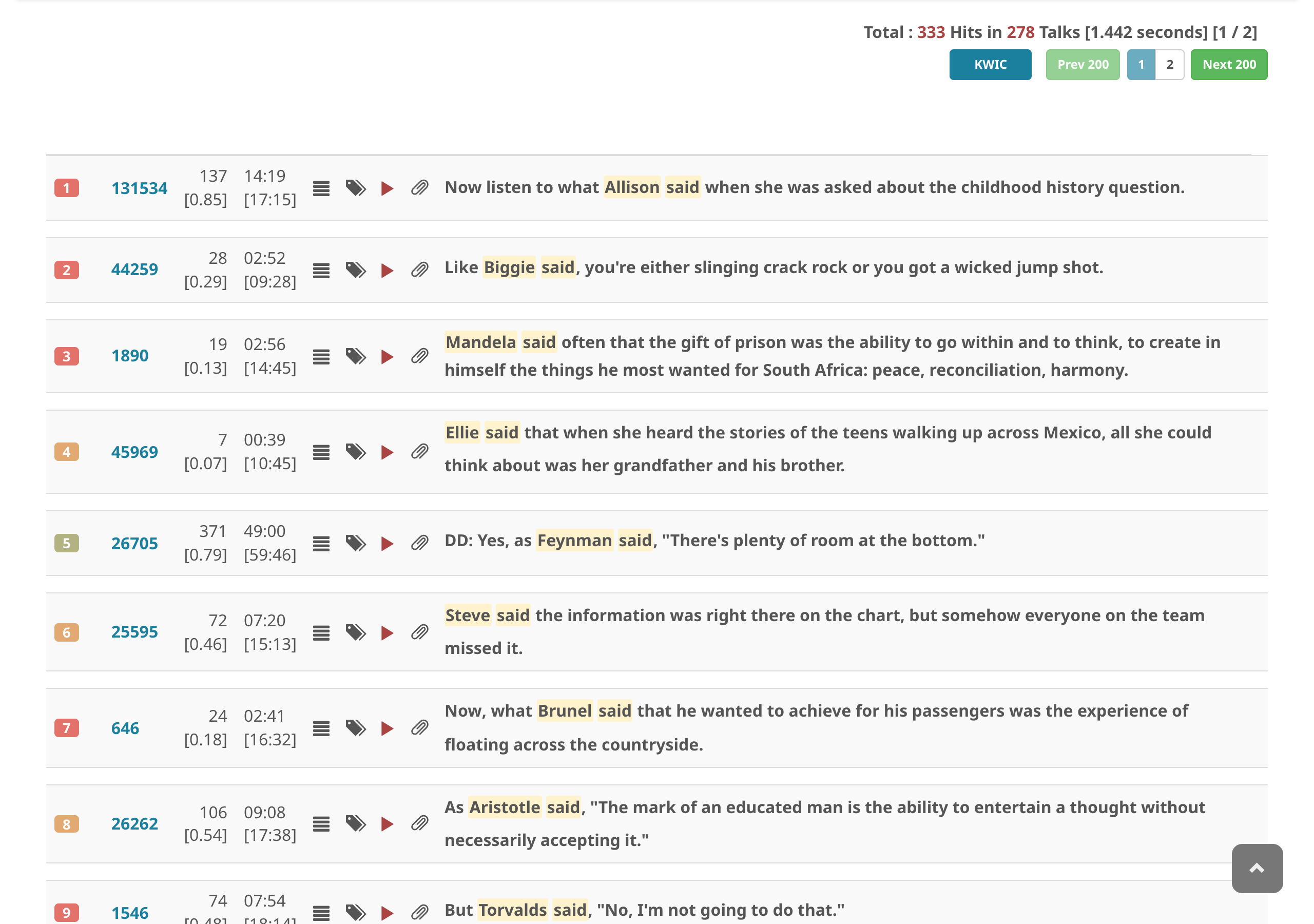
%PERSON said |
Person names followed by "said" |
in %GPE |
"in" followed by a country/city name |
%MONEY |
All monetary expressions |
%DATE |
All date expressions |
%ORG [be] |
Organization names followed by forms of "be" |
Entity types inside chunk conditions
Since v13.2.0, entity types can also constrain a noun chunk rather than a single token. _{%PERSON} matches a chunk whose head belongs to a PERSON entity, and types can be combined or mixed with other conditions:
| Query | What it finds |
|---|---|
_{%PERSON} |
Noun chunks headed by a person name |
_{%PERSON|%ORG} |
Chunks headed by a person or an organization |
_{pron|%PERSON} |
Chunks with a human referent (pronoun or person name) |
_{-%PERSON} |
The complement: every chunk not headed by a person name |
See Advanced Search Query Syntax for the full chunk-condition language.